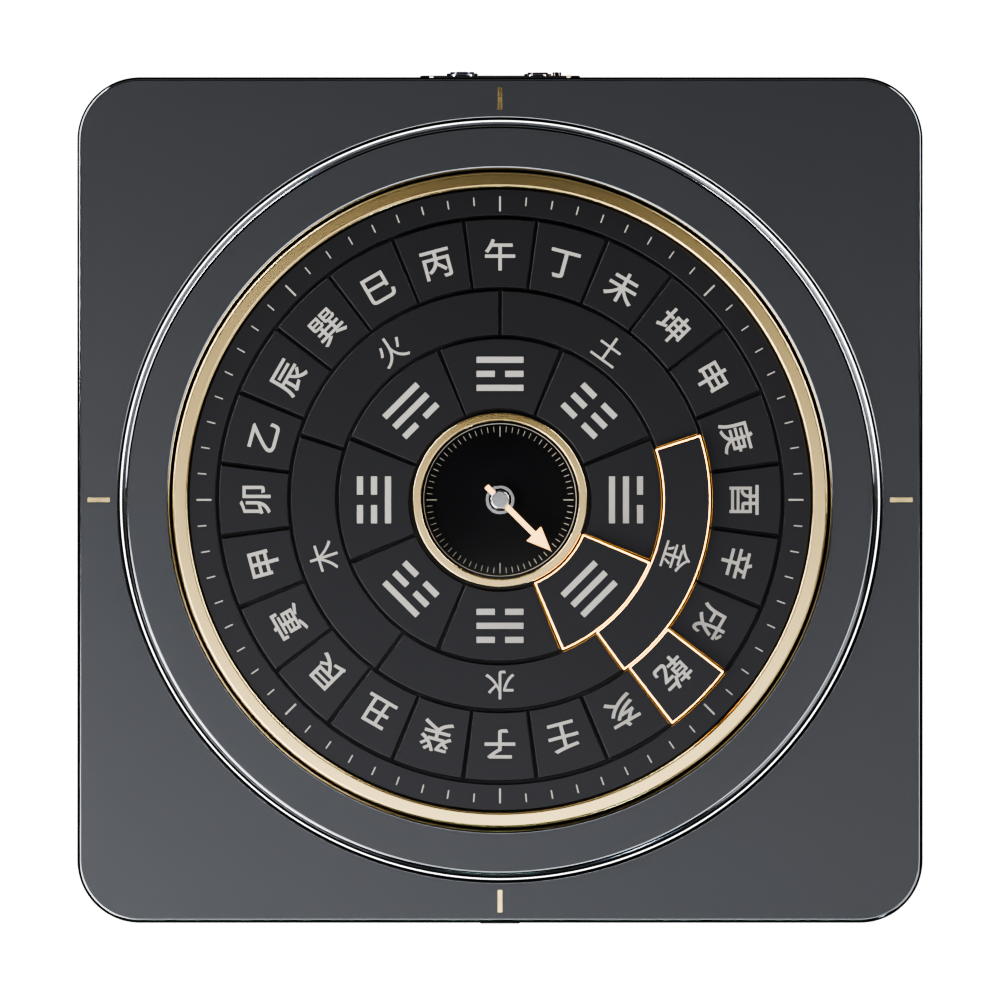
Feng Shui, literally wind and water, is a Chinese tradition concerned with the relationship between people, buildings, and their surroundings. Reading the form of a place and reading its orientation are related parts of that tradition. A Luopan brings the directional reading into a physical instrument, combining a magnetic compass with layers of symbolic information.
hyphencompass’s design gives three of those layers a tactile expression. The face stays fixed to the body, with 午 at the front. In the current design, a magnetometer reads the direction that front faces, and the center arrow indicates the heading on the dial. The website uses simulated headings to demonstrate this response.
The outer ring is 二十四山, the 24 Mountains. Each mountain spans 15 degrees. A mountain is a named directional sector here: the names combine the twelve earthly branches, eight heavenly stems, and four trigram names. The segment under the arrow rises as the indicated heading enters its sector.
The inner ring is 八卦, the Eight Trigrams. Each trigram governs three adjacent mountains, a relationship expressed as 一卦管三山. Its segment therefore remains raised through a 45-degree span. The mountain can change twice within that span while the governing trigram stays the same.
The middle ring is 五行, the Five Elements or Five Phases: Water, Wood, Fire, Earth, and Metal. These names describe relationships within traditional Chinese thought. In this instrument, the segment that rises follows the active mountain’s 正五行 assignment. It is a lookup relationship, so the element does not need to sit directly under the arrow.
This distinction matters. A heading of 315 degrees selects the mountain 乾, the trigram 乾, and 金, Metal. Moving to 300 degrees selects 戌 and 土, Earth, while the trigram remains 乾. The mountain and element change together; the trigram holds its position because both mountains belong to its sector.
At north, 坎 governs 壬, 子, and 癸, all assigned to Water. The next trigram, 艮, governs 丑, 艮, and 寅: the first two are Earth, while 寅 is Wood. This is why treating the Five Elements ring as five equal compass sectors would miss the relationships the design is intended to show.
The selected pieces rise approximately six millimeters, glowing from underneath as they lift. As the arrow leaves a sector, its mountain settles and the light fades. The governing trigram and element change only when their assignments change. Lowered pieces stay dark, keeping attention on the current reading.
The animated compass on the homepage presents these relationships as the heading changes. This is a specific design convention supplied for this instrument; different Luopan traditions can organize their rings differently.
Our aim is to make the relationships approachable without stripping away their cultural context. The moving pieces offer a starting point for learning how the rings connect. They are a demonstration of a prototype, rather than live sensor readings or a finished companion application.